
Category: 1 Player
Tiny paws. Massive riffs.
Concept art

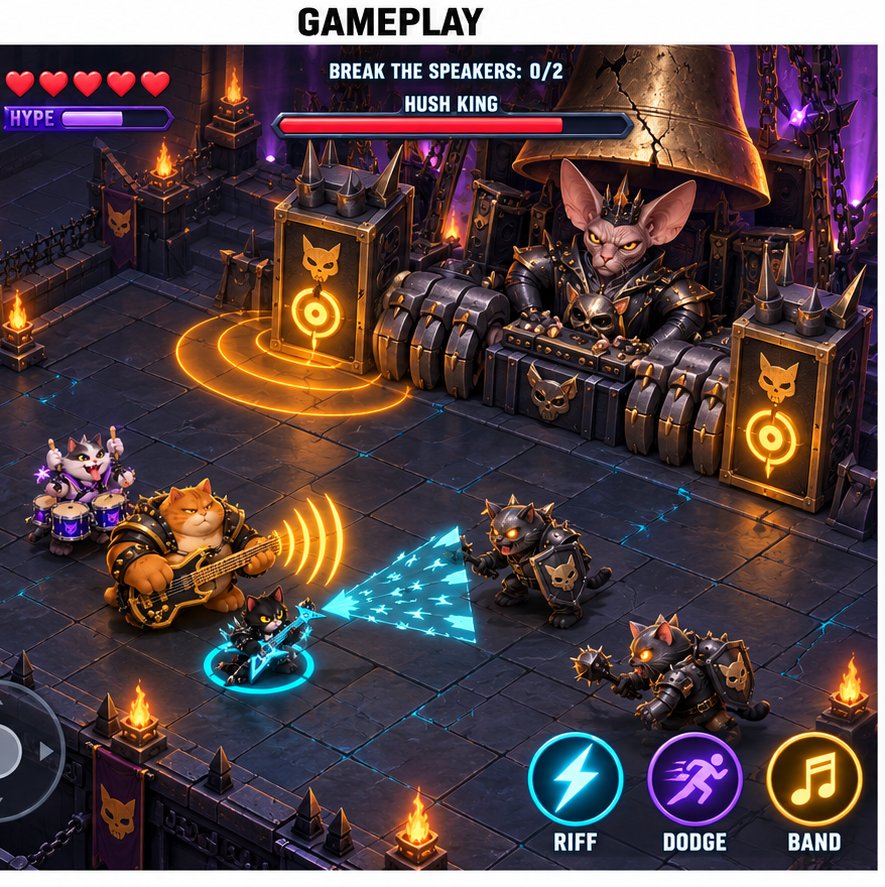
Nine Lives of Metal (Working title)
Status: NEW GAME BACKLOG ONLY — not green-lit. Added 2026-10-15. Do not build until the user green-lights.
Addition (user + kid-friendly note)
Add Cheech-and-Chong-style stoner cat characters who say “Dave’s not here, man”, with story-appropriate pop-art screens; they appear and move off screen at fitting moments in the story.
Keep it kid-friendly: no drug references, just the comedy duo vibe.
Reference art
concept-art-and-gameplay_USER.png— original attached sheet from the userconcept-cover-art.png— left half of that sheetconcept-gameplay.png— right half of that sheet- the user’s original attached
.mdlink (sandbox:/workspace/scratch/cee68e4ac016/Nine-Lives-of-Metal-Game-Design.md) was not on the box when this was filed.
The user’s design (verbatim from chat, 2026-10-15)
Add cheech and Chong cat characters saying Dave is not hear man with image story appropriate screen pop art and characters appearing and moving off screen at an appropriate time in the story intertwined with below game design
Build Nine Lives of Metal, a single-player isometric 3D action adventure for desktop and mobile browsers.
Tiny paws. Massive riffs.
Use exactly three levels, each containing three connected rooms. The player controls Buster while Butters and Gizmo follow and fight automatically. Complete the campaign in approximately 20–30 minutes.
1. Technical foundation. Use vanilla JavaScript, Three.js, HTML/CSS interface elements, and Web Audio. Bundle dependencies and assets locally. Produce a static build that runs without accounts, a backend, or external asset requests.
Construct characters and environments from reusable low-poly geometry. Animate model parts through parented transform pivots. Use one active room at a time.
Use an orthographic camera with a fixed isometric angle. Three.js provides the required orthographic projection. (Three.js Docs)
2. Story. Buster repairs equipment for the neighborhood band. Playing an ancient record backward transports Buster, Butters, and Gizmo into a world where music shapes the landscape.
The Hush King captures Butters and Gizmo and steals the inhabitants’ voices to power an enormous silence bell.
Buster must rescue his bandmates, recover the Rhythm Core and Melody Core, and stop the bell. His progression moves from attempting everything alone to understanding that the band’s combined sound is its greatest weapon.
Use brief portrait conversations. Show one line at a time, with no more than three lines per scene. Pause gameplay during conversations. Advance with a tap, click, Enter, or Space. Include Skip.
3. Characters and oversized modeling.
| Character | Appearance | Role |
|---|---|---|
| Buster | Smallest; black tuxedo; white mouth marking on one side; huge studded shoulder pads | Player-controlled guitarist |
| Butters | Largest; broad orange tabby; enormous paws; calm expression | Automatic bass companion |
| Gizmo | Medium-sized white-and-grey cat; expressive face; portable drum harness | Automatic percussion companion |
Set standing heights to 2 world units for Buster, 2.25 for Gizmo, and 2.6 for Butters.
Make heads approximately 40% of total height. Use short, thick legs, oversized paws, broad feet, giant instruments, and exaggerated armor. Buster’s guitar measures 2.3 units from tip to tip.
Preserve Buster’s asymmetrical white mouth marking. Place it on the viewer’s right in the model’s front view. Keep the upper nose black.
Build each cat from rounded low-poly forms, triangular ears, pronounced cheeks, a short muzzle, large eyes, thick limb segments, and a segmented curved tail. Represent fur with a few large tufts.
Animate breathing, blinking, walking, guitar swings, strumming, dodging, instrument recoil, comic defeat tumbles, and victory poses. Attach instruments to the torso and arm hierarchy.
Use charcoal stone, chrome, warm fur colors, electric cyan attacks, purple lighting, and amber danger warnings.
4. Isometric space and movement. Keep all gameplay on the X/Z ground plane. Y controls visual height only.
Set the camera to 45 degrees around the scene and 35.264 degrees above the ground. Keep that angle throughout gameplay.
Fit the camera to the active encounter when entering a room. Include the walkable floor, objectives, and boss weak points. Ease into the framing over 0.4 seconds. Keep the arena visible durin
y cue.
If performance remains below 28 fps for 3 seconds, reduce render scale by 15%, down to 60% of its initial value. Keep enemy counts and combat rules unchanged.
Run simulation at a fixed 60 updates per second and render separately. Limit catch-up to five updates per frame.
Pause on visibility loss or window blur. Freeze cooldowns, projectiles, warnings, wave timers, and boss states. Require an explicit Resume press and clear held input.
19. State management. Use explicit states for Title, Loading, Dialogue, Playing, Paused, Defeat, Upgrade, Ending, and Level Select.
Keep gameplay records separate from meshes. Give enemies, attacks, devices, waves, and boss components unique identifiers.
Resolve movement, AI, attacks, collisions, damage, defeat conditions, completion conditions, and visual animation in a consistent order.
Trigger each encounter clear, upgrade grant, and ending once only.
Dispose of room-specific objects and listeners on exit. Retain shared assets, interface, audio, and saved progress.
20. Fixed room placement. Center rooms at ground coordinate (0, 0). Positive Z is the entrance side. Place Buster 1.5 units inside the front boundary and the exit 1.5 units inside the rear boundary.
| Room | Floor | Main placement |
|---|---|---|
| Level 1, Room 1 | 18 × 12 | Butters’s cage at (-5, -3) |
| Level 1, Room 2 | 18 × 12 | Gizmo at (5, -3); speakers at (-5, 0) and (5, 0) |
| Level 1, Room 3 | 18 × 14 | Hairspray starts at (0, -3) |
| Level 2, Room 1 | 18 × 12 | Two obstacles and staggered floor hazards |
| Level 2, Room 2 | 20 × 16 | Stage at (0, -1); pillars at (-5, 1) and (5, 1) |
| Level 2, Room 3 | 18 × 14 | Organ at (0, -3); phantoms at (-4, 0) and (4, 0) |
| Level 3, Room 1 | 18 × 12 | Open central combat floor |
| Level 3, Room 2 | 18 × 14 | Amplifiers at (-5, 0) and (5, 0) |
| Level 3, Room 3 | 20 × 16 | Throne at (0, -6); speakers at (-4, -3) and (4, -3); core at (0, -3) |
Place ordinary spawn portals around the rear corners and rear center. Select a reachable portal at least 3 units from Buster.
Keep decorative scenery outside the walkable perimeter. In the Mourning Hall approach, place two 2 × 2 obstacles at (-3, -1) and (3, 1). Place 3 × 1.5 hazard rectangles at (-2, 2) and (2, -2).
21. Completion requirements.
- All nine rooms connect into exactly three levels.
- Keyboard and multitouch support simultaneous movement and abilities.
- All combat uses ground-plane collision.
- Every objective and boss weak point remains reachable.
- Companion navigation cannot block progression.
- Enemy waves terminate correctly under the six-enemy cap.
- Boss warnings match their actual damage regions.
- Immune targets grant no damage or Hype.
- Stage defense ends after three waves and two destroyed pillars.
- Final Solo always becomes available after the core breaks.
- Retry, refresh, and replay preserve valid progression.
- Pausing freezes all gameplay.
- Muted audio never prevents play.
- Completing the final performance unlocks replay of all three levels.